16.7.17

"Grandfather and Grandson" Tsunami Survivors.. Bande Aceh, Indonesia

CAPTION
This man, a grandfather, holds his young grandson on the road to the sea behind what used to be his home. The waves came ashore quickly and swept back to sea, again and again, scraping and stripping the earth of every living thing – growing more powerful with each wave until there was nothing left. We saw each other at the side of the road, and I stopped and asked to photograph him – quietly he shared his story of outrunning "waves as tall as the palm trees" that stand behind him. He was on a scooter when the first wave came ashore, but it soon rushed back out to sea with the birds, the air – drawn silent. He sensed danger, hearing a growing rumble out to sea, and then over his shoulder he could see a new wave building – instinctively he grabbed his boy and literally had to run for their lives. They were very lucky that day to have survived. Nearly a quarter of a million others – did not.

Two weeks after the 2004 Indian Ocean Tsunami drove mercilessly across open ocean to hit the coastlines of some 14 countries, I was initially on the ground in India for Food for the Hungry US, to cover the tragedy and the global response that was being rushed to the region. Straight from the airport to the beach, literally the funeral pyres were still smoldering while women wailed into the offshore winds at the searing pain of losing their babies and complete families – the waves taking dreams, hopes, laughter and life – without a kiss goodbye. It would be my first time in a relief zone – naively thinking India was as bad as it gets. I was wrong.

After 10 days up and down the eastern coastline, I asked to be sent to Indonesia, to Banda Aceh, to begin documenting the carnage at the centre of the greatest natural tragedy on earth. I would spend weeks in the region and return for years that followed. Each and every visit, I would find myself pulled under by the memory of stories I heard, the broken hearted sobbing and images of death from what felt truly like The Apocalypse had been unleashed. 

To share just one moment is the best I can do tonight but – my time in Banda Aceh stole my ability to speak, it reduced me to constant tears having spent far too long without relief in the midst of tortured souls trying to come to grips with having lost their entire world. 

A few flashes of those times tonight – still brings me to my knees.

2.7.17

"Emily - A Tribal Nomad" Meru, Kenya

CAPTION
Emily is a nomadic MERU tribeswoman from the desolate, arid desert lands of northern Kenya. I spent a few days with her family at her humble home, while on assignment to create a "Day in the Life" for The Paradigm Project. In Emily I found a strong, tireless and quietly driven woman who wakes up with the cooling of the earths surface, makes a raw wood fire to warm her daughter and her baby goat, while preparing a meagre meal of crusted break and chai for her son before he goes to school. At dawn she tends her sheep, hauls more wood on her bare back from miles away from home, searches for precious water supplies, tries to save a few garden plants from the scorching sun, and is doing everything she can to make sure her children are getting well schooled. While most of us will never suffer the effects of a drought – an endless numbing drought that has dried up most of the open water sources for cattle and humans to drink for thousands of square miles, at 42, Emily's story of strife is commonplace. 

"Emily's Story" Meru, Kenya
"She shares a daily struggle to survive with women across the globe yet you'll never see her cry. Never see her beg. Never see her complain. Instead she is strong, fiercely determined, full of dignity, yet even with so little for her and her children to eat, will open her humble home and extend her scarred hands to share with you what little she has..."

If you have time read the full story, it will give you a feeling of how one woman lives her life in the developing world - faced with so much hardship yet Emily never gives up.. because every single day demands a fight for survival in Kenya's arid lands, where ongoing drought brings suffering to everyone.


19.6.17

"Survivor-Evelyn's Girl" Jacmel, Haiti


CAPTION
This young girl is one of Evelyn's children photographed over a three week period while on assignment for Suisse based MEDAIR and The Paradigm Project - shortly after the tremors from the 2015 Haitian earthquake calmed down. Like many who escaped the initial impact of such a violent tragedy, Evelyn and her daughter did the best they could. Evelyn held a piece of wood in her hand to protect them as they slept, too dangerous to stay in her damaged home and hearing rumors of a different kind of danger for women and girls if she went to the relief camps living in tents. So they stayed together on a dirty sheet until it was their turn to receive assistance. 

But beyond the initial impact the Haitian earthquake like all tragedies, keeps visiting the survivors in their sleep, in their dreams, hearing voices and replaying images in their head, while guilt becomes a constant companion for never having had a chance to say good bye or asking themselves - why did I survive. The United Nations stated that the loss to those who survived the 2015 Haitian earthquake was enormous with over 1.5 million children under the age of 18 effected by the tragedy - much of it personally experienced. They lost complete families, lost generations of mothers and fathers, brothers and sisters, with laughter and dreams exchanged for nightmares, screams and fear. The sights and sounds of such enormous human loss, the emotions felt in losing loved ones, will be forever trapped inside young minds with memories and experiences more dark than not. A survivor yes thankfully - yet forever scarred.

12.6.17

"Evelyn" Jacmel, Haiti

CAPTION
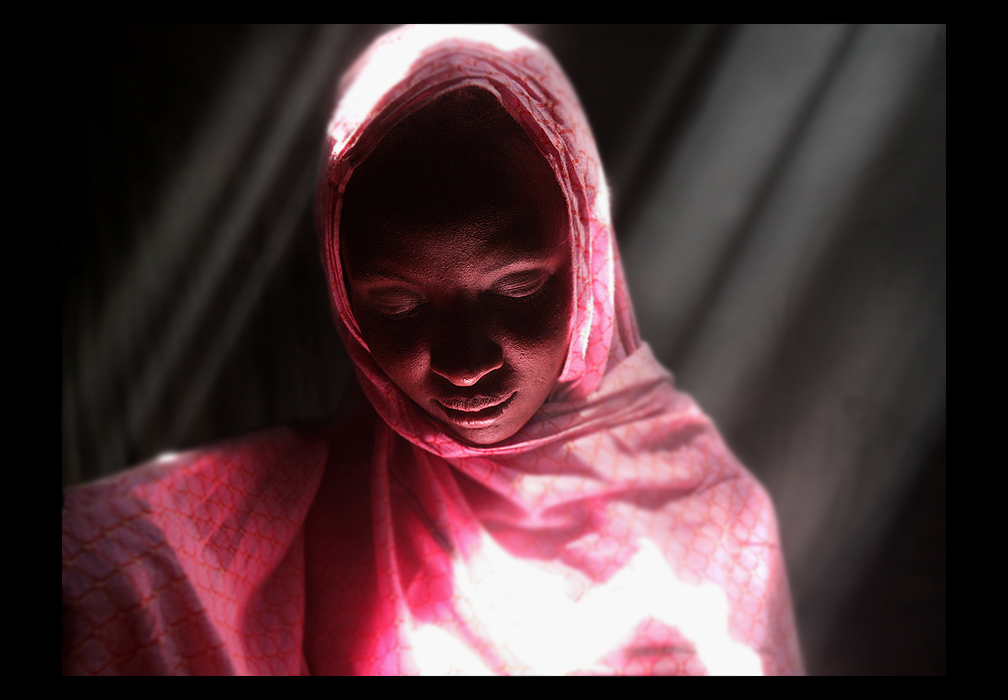
While not everyone survived this immense tragedy, those that did were trying to sort out their lives by asking questions on which way to turn, how to move forward, where to find work and what to do with themselves as they deal with the enormous pain for having lost loved ones underneath the debris. Still more pressing questions remain each day. Where will I sleep. Where can I find something to eat. Is my family safe tonight while they sleep and how do I take care of my babies when I have nothing left to give. Evelyn slept on the dirt with her babies for six weeks, too afraid to sleep inside her humble, red walled single roomed home, with finger sized fissures and cracks form floor to ceiling from the earthquake that took so many of her neighbors lives. In this image, on one morning, she was less concerned about her own life than she was about finding food, any food, and a bit of brown water from the river..for her babies. 

30.5.17

"Pink Gabbra" Torbi, Kenya

CAPTION
In the early dawn hours, the desert can be bitter cold. There's no central heating in the arid lands of northern Kenya, and the wood fire that burned bright at night, smolders to ashen grey in the corner of the hut. This young Kenyan Gabbra woman seeks a bit of warmth from the streaking rays of the morning sun - its' shafts piercing holes through the twig roof of her animal skin draped hut. A nomad, her tribe will soon pull up stakes and drive camels and cows to the next overgrazed piece of grass, and a mud hole - used for drinking water by both man and beast.

26.5.17

"Father and Son" Alta Verapaz, Guatemala

CAPTION
Knowing one day his boy will take his place in the family and in the village, he begins to train him up early, to prepare him, for the duties he must accept in the years ahead in supporting the family. Wood primarily is needed for fires to boil water, to cook meals and in the colder months in the Alta Verapaz, for heat. This means that wood is collected, traditionally the work of women - large pieces like this by men, each and every day of their lives. However the hardships won't end with collecting wood – the toxins absorbed while inhaling the smoke caused by open wood fires located inside the home, will take over 6million lives across the globe - each year. 

Created on assignment for organizations which are engaged and dedicated to implement the clean cookstove initiative, culturally and effectively worldwide, to reduce the fatalities from simply cooking their daily meals. View their work at the United Nations Foundation's Global Alliance for Clean Cookstoves (UNF-GACC).


23.5.17

"Nelvy" Cochabamba, Bolivia

CAPTION
"Nelvy" A young, sick campesino daughter in the arms of her protective father, living in rural Cochabamba, Bolivia

BACKSTORY

I came across this child while on assignment in Bolivia for Food for The Hungry. She lived a humble life as the daughter of hard working campesinos in one of the campo's very poor farming communities that dot the Bolivian landscape. During a casual visit, while standing in the doorway speaking with her mother and father, I noticed in the far corner of the room behind them, the shape of a small child laying down behind a set of makeshift curtains. 

I was told her name was "Nelvy" and with that they summoned a quiet, little waif of a girl, who came and stood quietly in front of me, silent 
with eyes like pieces of coal, her fathers arms wrapped protectively around her tiny shoulders. When I asked about her I didn't expect to be told that she didn't have long to live, maybe a year, maybe less...due to a hole in her heart. I was speechless and blurted out "why are you talking about her like this in front of her" softly they said that "she knows." I learned that while there was a doctor willing to perform the surgery they had no money for the nearly $4500 needed for post operative care which for a humble farmer, might as well have been a million dollars. In a breath I had a wave of emotion flood over me, thinking...there was no way on earth I was going to let this little girl die for lack of money. So I changed the photograph from a casual editorial image - to a poignant, face to face photograph that would help to save a young girls life.

After a long flight back to to the States, I stumbled into one of the barns at a nearby Arabian Horse show. They were closing the barns and taking the horses out to trailers, when out of the darkness destiny came knocking, in a woman named "Carol" 
a horsewoman from Daydream Arabians, who took particular interest in my latest assignment to Bolivia, telling me that she'd been wanting to help in some way but didn't know how. Well, at the beginning of a very long story, I bluntly told Carol that I needed $5,000 to help save a little girls life or simply - she would die. Carol just stared at me. And with that I left the horse barn that night, where I found Carol, and thought little 
more about our meeting until a week later when a check arrived in the mail for $5,000, with Nelvy's name on it, for her open heart surgery. I'm surprised that this morning in London, years later since that fateful morning in Bolivia, tears still find me with the memory of what Carol's generosity meant. Nelvy would live, and her mother and father, so brave to let their daughter go through major surgery, would enjoy many years with their daughter they believed would be lost. It still resonates with me, personally knowing the names of children who came after Nelvy, from East Africa to The Philippines, Carol helped with those children too, who were vulnerable and simply needed an advocate to stand up for them.


With the help of so many people, including Food for the Hungry's staff in Bolivia, Nelvy had a successful operation and has been running 
around rural Bolivia for quite a few years, enjoying a full life with her family, and I believe she has children of her own now. She must've had a sense of peace, knowing that she has a strong heart now, to help her live out her dreams and maybe a bit of wonderment, of how strangers found her in the rural wilds of Bolivia that fateful day. Nelvy's story is a truly special story, one that has provided the motivation behind other heart operations around the globe thru the creation of the HEART fund with Food for The Hungry, whereby children in rural communities of the developing world, who are critically ill, may find help. 
A few poignant images, a woman in a barn, a bit of money and a beating heart in all of us made the difference. When asked to help we simply stepped up and said "yes" when we could easily have said no. We shared a vision for something good for a change and along the way we managed to play a small part in helping to give a little girl, to give Nelvy - back her life.